5 Questions to Ask Before You Commit to the Great Loop

Let me be upfront about something before we start.
This is not a post designed to talk you out of the Great Loop. If you've been dreaming about it, reading about it, lying awake thinking about what it would actually feel like to cast off the lines and go… that instinct is real, and it deserves to be taken seriously.
But the Loopers who have the best experiences aren't necessarily the ones with the biggest boats or the most experience. They're the ones who went in clear-eyed. Who had the honest conversations before they left the dock. Who knew what they were actually signing up for. Not the Instagram version, but the real one.
So here are five questions worth sitting with before you commit. Not to create doubt. To create clarity.
1. Are we aligned on what “doing the Loop” actually means, day to day?
This question matters most for couples, and it's the one that catches people most off guard.
It's easy to agree on the big picture. Yes, we want to do the Loop. Yes, we want the adventure. Yes, we're excited. But the big picture is made up of a thousand small days, and those days look like: waking up early to catch a tide, spending three hours waiting at a lock, arriving somewhere new and having to figure out a marina you've never docked at before, cooking dinner in a small galley after a long passage, and then doing it all again tomorrow.
Before you commit, have the granular conversation. Who's driving and when? Who handles lines? What happens when one of you is exhausted, and the other wants to keep moving? What does a “day off” look like on a boat?
These aren't dealbreakers; they're just details that are much easier to work out at the kitchen table than at a fuel dock 400 miles from home.
2. Do we have a realistic sense of what this costs?
The Great Loop can be done on a wide range of budgets, and people do it successfully at almost every point on that spectrum. But “it's doable on any budget” is not the same as “it costs whatever you're hoping it costs.”
Fuel is the biggest variable, and if you're on a powerboat doing the full loop, it's significant. Add marina fees, maintenance and repairs (because things will break, full stop), provisioning, pump-out fees, insurance, communications, and the occasional night in a town where you just need a real meal and a proper bed… and the number adds up faster than most people's early estimates.
The question isn't whether you can afford it. The question is whether your number and the Loop's actual number are close enough that you won't be making stressful financial decisions in the middle of the trip.
Spend some real time with the budget before you go. Talk to Loopers who've recently finished about what they actually spent. Build in a contingency, and then build in a little more. The Loop is too good an experience to spend it anxious about money.
3. Is our boat genuinely ready, or are we hoping it will be?
There is a version of Loop preparation that goes: we'll sort the rest out on the way. And honestly? A certain amount of that is unavoidable and even healthy. You will never have a perfectly ready boat. Nobody does.
But there's a difference between minor things you'll address as they come up, and known issues you're quietly hoping won't become problems on the water.
If your engine needs work, get it done before you leave. If your bilge pump is questionable, replace it. If there's a through-hull fitting you've been meaning to look at, look at it now. The Loop takes you through everything from protected ICW to open Gulf crossings to rivers with commercial traffic, and the mechanical gremlins that feel manageable at the dock have a way of becoming very unmanageable in a difficult spot.
Get a good survey if you haven't recently. Have a trusted mechanic go through the systems. Know what you're working with.
A well-prepared boat doesn't guarantee a smooth Loop. But it gives you a much better shot at one.
4. How do we handle stress… individually and together?
This one sounds like a therapy question. It kind of is. And it matters.
The Loop will stress you out. Not every day, not even most days… but it will happen. Weather windows that close unexpectedly. Groundings. Equipment failures at inconvenient times. Exhaustion. The occasional morning where the coffee maker breaks and the holding tank needs pumping, and it's raining, and you have 40 miles to cover before dark.
How do you respond when things go sideways? Do you shut down or talk it out? Do you get sharp with each other under pressure, and if so, do you recover quickly? Do you have a way of checking in honestly when someone's not okay?
None of these have wrong answers. But knowing your patterns before you go (and talking openly about them) makes a real difference out there. The Loopers who struggle most aren't usually the ones who hit hard moments. They're the ones who didn't have a way to talk about them.
5. What are we hoping this changes?
This is the quietest question on the list, and maybe the most important one.
A lot of people come to the Great Loop carrying something. A season of life they're ready to leave behind. A relationship they want to reconnect with. A version of themselves they're hoping to find out there. A need to slow down, or prove something, or just feel genuinely alive for a sustained stretch of time.
All of that is valid. The Loop is genuinely transformative for a lot of people. But it's worth being honest with yourself about what you're bringing on board because the boat doesn't change what you carry. It just gives you a lot of quiet miles to sit with it.
If you're hoping the Loop will fix something that's broken on land, be gentle with that expectation. If you're hoping it will give you space to grow, or reconnect, or simply experience something extraordinary together, that one it delivers on, reliably and generously.
Know what you're looking for. It helps you find it.
So… should you do the Great Loop?
If you've read this far and none of these questions made you want to close the tab, that tells you something.
The people who thrive on the Loop aren't the ones who had no doubts. They're the ones who looked at the real thing — the budget and the boat and the stress and the small days — and decided it was worth it anyway.
If that's you, start preparing. Seriously. Not someday… now. Get the survey done, have the conversations, build the spreadsheet, join the AGLCA. The dreamers who become Loopers are the ones who start treating the dream like a plan.
The water is out there waiting. And it's worth every bit of what it asks of you.
We’d Love to Hear From You!
Which of these questions caught you off guard, or is one you're still sitting with? Drop it in the comments. I'd love to talk through it with you.
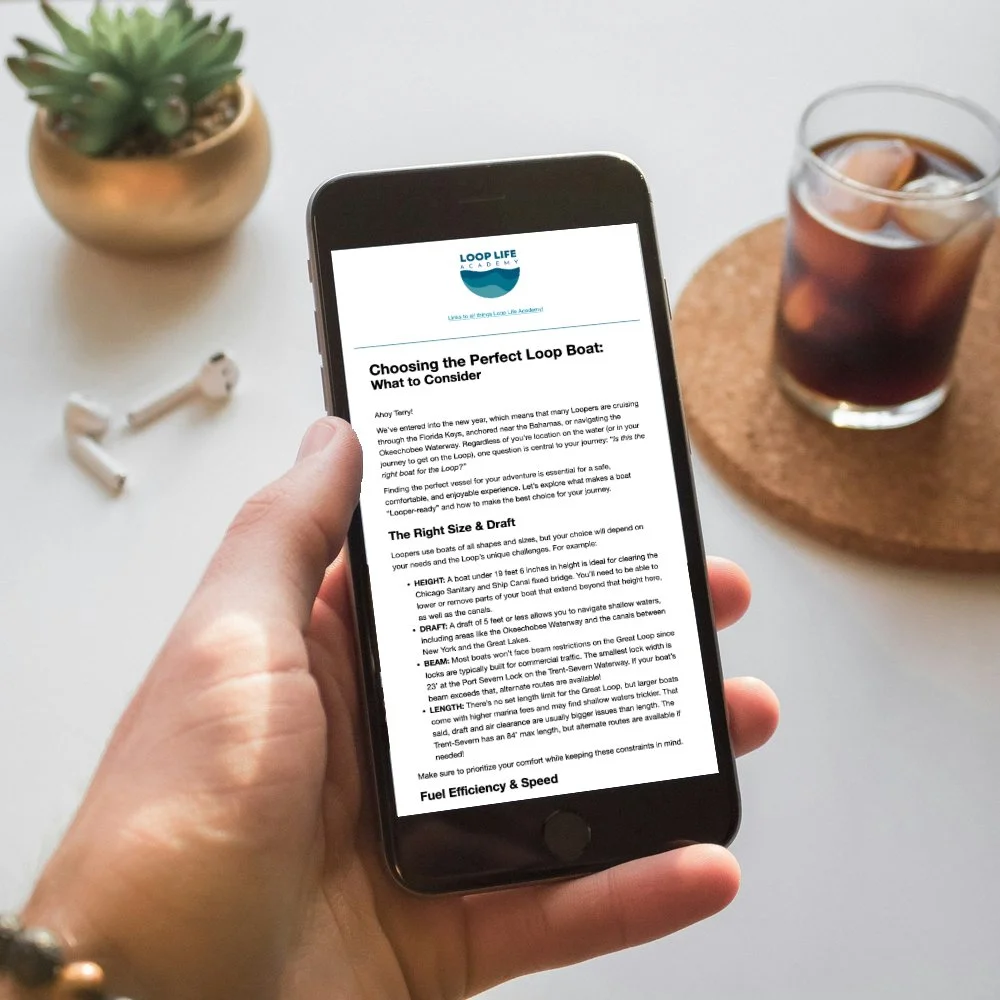
Ready to go from dreamer to planner? Our regular emails are packed with practical tips, honest advice, and the occasional nudge to keep moving. Sign up and stay in the loop.
If you’re ready for more Great Loop insights, our regular emails are just what you need!
You’ll get fresh tips, updates on new blog posts, videos, podcasts, and a chance to catch up on older content you might have missed.
Don’t miss out on practical advice and inspiration for your Loop journey!