What to Look for in a Marine Forecast (Even If You’re Not a Weather Nerd)

You don’t need to memorize every cloud type or understand pressure gradients to cruise safely. But you do need to learn how to interpret a marine forecast—and more importantly, how to make a “go/no-go” decision from it.
After thousands of miles cruising the Great Loop (and a few surprises along the way), here are the top things we now always check in the forecast.
1. Wind Direction and Speed (Not Just Gusts)
We look for sustained wind speed in our travel window—not just the gusts.
Gusts tell you how “puffy” it will feel, but consistent winds over 20 knots from an exposed direction are usually our no-go threshold.
A 10–15 knot headwind feels very different than the same wind on your beam or quarter.
2. Waves: Height, Frequency, and Period
If you only look at wave height, you’re missing the full picture. A 2-foot wave every 10 seconds feels like a gentle ocean swell. A 2-foot wave every 2 seconds? That’s a choppy mess.
We look at:
Wave height (in feet or meters)
Wave period (in seconds)
Wave direction relative to our heading
Apps like Windy or PredictWind often have this info in one place. The longer the period, the smoother the ride.
3. Check the Timing of Updates and Trends
Some weather models update hourly (like HRRR); others only 2–4 times per day (like GFS or NAM). That matters because:
Morning data might be stale by afternoon
Forecasts change—and fast
We don’t trust a single screenshot. Instead, we compare a few models and watch for either convergence (multiple models saying the same thing) or divergence (they all disagree). That tells us whether the forecast is solid or still “shaky.”
✅ Key takeaway: When you see an abrupt 180º wind shift—like S → N—that’s a classic pattern ahead of a front. Big 180° wind shifts often mean a system is moving through and weather is about to change. Watch for this trend across multiple forecast hours.
Our Go-To Forecast Tools
Windy.app – Has multiple models (GFS, ECMWF, HRRR, etc.). You can toggle between them and see how much they agree or disagree.
NOAA Marine Forecasts – Great for general trends, especially nearshore and offshore zones.
WeatherBug (Marine tab) – User-friendly with a solid hour-by-hour forecast.
Remember: these apps aren’t necessarily the forecast themselves—they’re showing you the output of different models. That’s why understanding the timing and comparison matters.
A Final Word: You Don’t Have to Be an Expert
We’re not weather nerds. But we are cautious cruisers, and we’ve learned (sometimes the hard way) which clues usually tell the truth.
Trust your gut. Build buffer days. And when in doubt, stay put.
We’d Love to Hear From You!
What’s your go-to app or weather strategy before a cruising day? Have you ever been surprised by a “perfect” forecast?
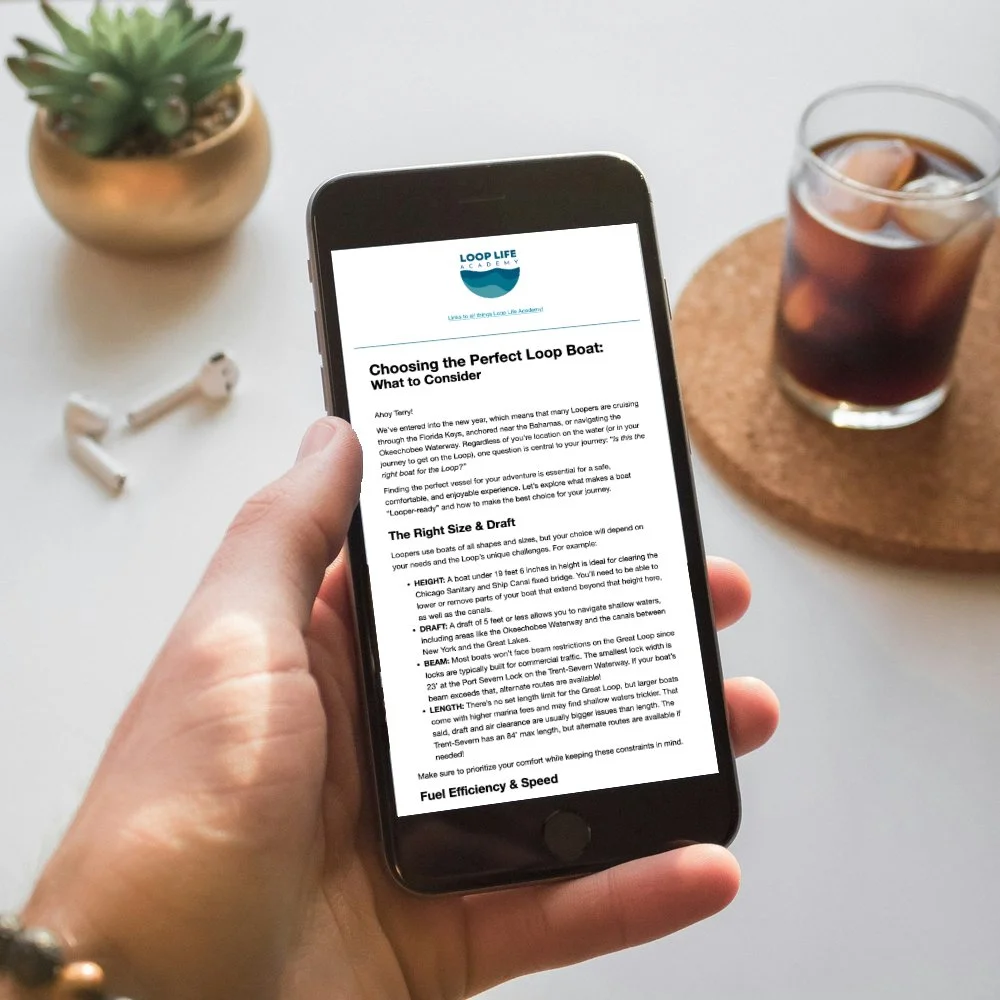
Want more of what you see here?
If you’re ready for more Great Loop insights, my weekly emails are just what you need!
Each week, you’ll get fresh tips, updates on new blog posts, videos, podcasts, and a chance to catch up on older content you might have missed.
Don’t miss out on practical advice and inspiration for your Loop journey!