How to Play: 4-Card Golf
We recently learned the card game Golf, which was easy to teach to a group. It requires mostly luck and not a lot of skill.
Looking up the formal rules for the game, we learned that 6 Card Golf is more common and can be great for large groups. Below are the rules we learned for a 4 Card Golf variation.
Looking for more game rules that you can try? See all of our blog posts tagged with Game Rules.
4-Card Golf
We enjoy this game as it’s quick to learn and doesn’t take too long to go around the group for a round.
We’ve played with as few as two people and as many as eight people with a single deck.
With eight people, we needed to shuffle the discard pile once to have enough cards in the draw pile for all four times around the table.
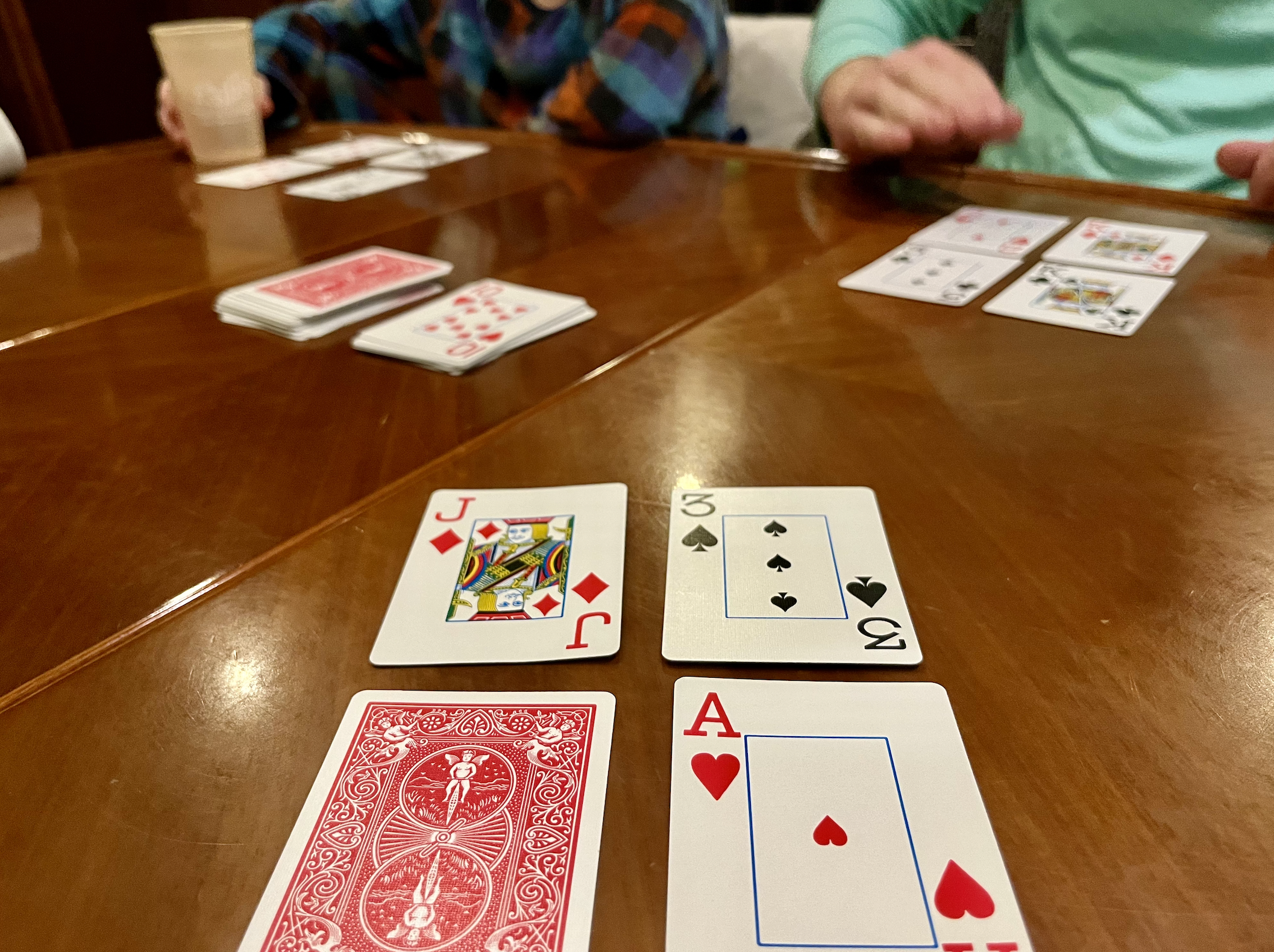
To the left, you’ll see how we arrange our four cards in a 2x2 grid, flipping one card over each turn.
Game Information
Game Objective
Your goal is to get the least points (like the regular game of golf). You do this by swapping your cards for ones with smaller values or pairing them up with other cards that match rank.
Number of Players
This game is usually played with two or more players.
Playing Time
You can play just a few rounds and keep the game fairly short, or you can play nine rounds and see who has the lowest score.
Supplies
A standard deck of playing cards (including jokers)
Recommended Ages
This game is suitable for all ages, but some ability to handle basic addition and subtraction is helpful.
Game Rules
We have a pretty loose set of rules to make it easy to explain. Plenty of variations exist, but this is how we learned.
Setup:
Choose a dealer. They will deal four cards to each player, arranging them in a 2x2 grid, all face down. Flip the top card of the deck and start a discard pile.Only Look:
Each player may look at two of their facedown cards, then put them back in the same spots, face down. They have to remember what they are and can’t look again. This can help you decide which cards to discard or keep during your turns!First Time Around:
The first player to go is the one to the left of the dealer.Draw a card from the face-up discard pile or the face-down draw pile.
The card drawn from one of the piles can either be swapped for one of your face-down cards or discarded (you cannot discard cards from the discard pile).
A card must be turned face up.
If the card is swapped for one in your 2x2 grid, that swapped card must be face up.
If the drawn card is discarded, choose any card from your 2x2 grid to turn face up.
Continue to your left.
Second, Third, and Fourth Times Around:
The gameplay continues the same way as the first time, with another card turned face up each time. By the fourth time around, all cards will be face up.
NOTE: If you have a matching pair face up, those cards cancel each other out.
Example: two 9’s in your grid equal zero pointsScoring:
After going around four times and having all cards face-up, you can score the round using the point values below.
You can end the game after one round or keep track of total values over multiple rounds.
When you decide to finish (play nine rounds or until someone reaches 50 or 100 points).
The winner has the lowest number of points.
Scoring
Joker: -6 points
2 Jokers: -12 points
Matching Pairs: 0 points
3 of a Kind: -4 points
4 of a Kind: -12 points
Kings: 0 points
Aces: 1 point
Jacks & Queens: 10 points
Number Cards (2 to 10): face value
Great for Kids
This game is great for building several skills:
Math Skills - identify and form matching sets, addition, subtraction
Social Skills - explaining the game and interacting with other players
Fine Motor Skills - picking up cards, holding cards, discarding
Good Sportsmanship - this game is based a lot on luck, and sometimes the score is out of a player’s control; they may need to learn to lose gracefully, as they can’t always control their destiny in this game!