The Best Board Games for Life on a Boat (Tested on the Great Loop)
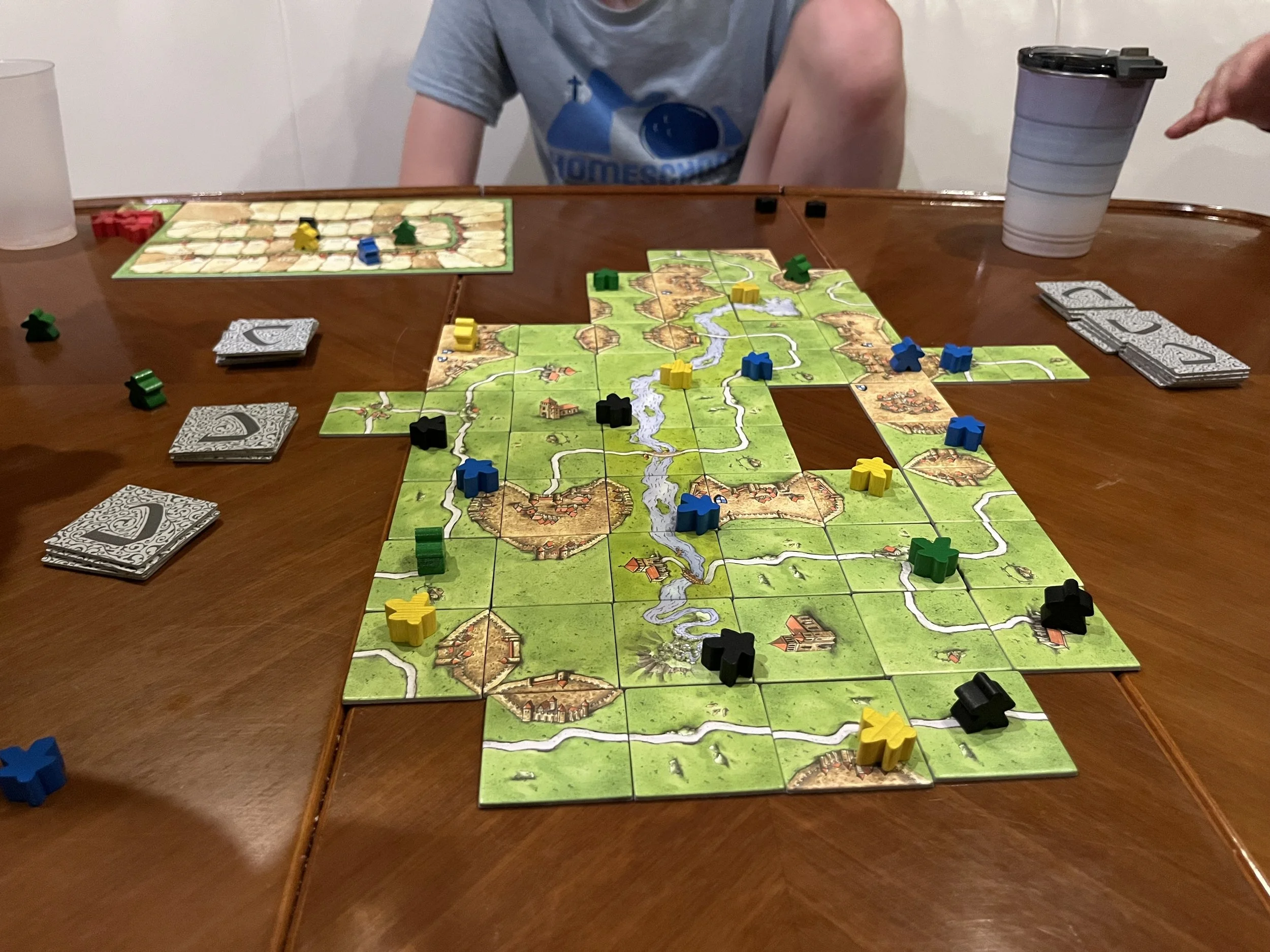
Playing Carcassonne on our boat, S/V Fika.
Here is something nobody puts in the cruising guides: you are going to have a lot of evenings on the hook.
Beautiful evenings, mostly. Quiet anchorages, dinner done, kids winding down, the boat gently moving. And after a few weeks of that, you are going to want something to do that isn't a screen.
We came aboard with a stack of games over the years. Some became staples we played dozens of times. Some got opened once and quietly relocated to the bottom of a locker. And a few things we didn't discover until we were already out there became instant favorites.
Here's what we learned, and what we'd bring again.
First: what makes a game actually work on a boat?
Before the list, it helps to know the criteria, because boat-worthy is genuinely different from living-room-worthy.
Size and storage matter enormously. A big box game with a large folding board and fifty components is going to be a problem in a small salon. You want games that store flat, pack compactly, and don't have tiny pieces that roll into the bilge the moment someone sneezes.
Durability counts. Cards get handled with slightly damp or sunscreened hands. Boxes live in lockers that shift underway. Anything in flimsy cardboard takes a beating from the humidity and the handling.
Play time needs to be flexible… and honestly, shorter is often better. After a long passage day, your brain is tired. When the kids want to break out something complicated and long, sometimes the honest answer is: not tonight. Having a mix of substantial games and genuinely easy ones means you always have something that fits the energy level of the evening.
And when you're playing with the same crew night after night for months, you want games that work across ages and moods. Not ones where the adults are secretly bored, or the kids are genuinely lost.
With all that in mind, here's what earned its place on SV Fika.
Carcassonne
Our most-played game this cruising season, and the one that surprised us most by how well it grew with our kids as they got older.
It's a tile-laying game where you're building a medieval landscape together — roads, cities, farms, monasteries — while quietly competing for points. The rules are simple enough to explain in a few minutes, but there's real strategy underneath once you've played a few times. That combination is the sweet spot for family cruising: easy to start, interesting enough to keep coming back to.
The components are sturdy tiles that store neatly, the box is a manageable size, and it plays in about 45 minutes. We've played it at anchor, at the dock waiting out weather, and on rainy afternoons when nobody wanted to go anywhere.
If you only bring one box game, this is the one we'd recommend right now.
Unstable Unicorns
Our current favorite card game, and the one our kids reach for most. It's a strategic card game where you're trying to build a herd of unicorns while sabotaging everyone else's… Chaotic, funny, and surprisingly tactical once you know the cards.
It comes in a compact box, the cards are sturdy, and it plays in 30–45 minutes, depending on how much chaos is happening at any given moment. The chaos, for the record, is considerable. This is not a quiet, contemplative game. It is a game where your carefully constructed herd can be demolished on someone else's turn, and you have to laugh about it.
For families with older kids who can handle a little friendly sabotage, it's a great fit. We've gotten a lot of good evenings out of this one.
Forbidden Island
A cooperative game we were recently introduced to and immediately loved. Everyone plays together against the game, trying to recover four sacred treasures from an island that is actively sinking beneath you. You win or lose as a team.
This one changed the dynamic of our game nights in the best way. After a day where everyone has been pulling together on the water, there's something satisfying about sitting down to a game where you're still on the same side. Nobody goes to bed feeling beaten. Everyone either celebrates or commiserates together, and both outcomes make for a good evening.
It's compact, plays in about 45 minutes, and the difficulty adjusts so it works for a range of ages. A genuinely good addition to the boat game bag.
Sushi Go!
Small card game, fits in a jacket pocket, plays in 15–20 minutes. This is the game you reach for when your brain is done, and you still want to do something… Waiting at a lock, killing time before a weather window, filling the gap between dinner and dishes.
It's a card-drafting game where you're collecting the best combination of sushi dishes as they pass around the table. The rules take two minutes to explain. The cute illustrated cards hold up well to cruising life. And it generates a surprising amount of laughter for something so small and simple.
The low barrier to getting it out is its best feature. When the other games feel like too much to set up and explain, Sushi Go! is an easy answer.
Pass the Pigs
Two little rubber pigs in a tiny plastic case. You roll them like dice, score points based on how they land, and decide whether to bank your points or keep rolling and risk losing them. That's it.
This one is perfect for evenings when you want to hold a conversation at the same time. It requires just enough attention to be fun without demanding your full focus. We've played it in cockpits, at marina picnic tables, waiting for food at restaurants, and with other cruisers at the dock. It always generates more laughter than you'd expect from two rubber pigs.
Also, nearly indestructible, which counts for a lot on a boat.
Chess
This one we didn't expect, but it's worth mentioning because it came up again and again across the cruising community: chess is genuinely popular among boat kids.
There's something about life on the water that lends itself to it… The slower pace, the time to think, the lack of screens demanding your attention. We've watched kids who'd never been particularly interested in chess at home pick it up seriously once they were living aboard.
The practical note: a travel chess set is worth having over a standard board. Something magnetic or with pieces that store in the board itself is ideal. It packs flat, the pieces don't go anywhere if the boat moves, and it's easy to carry to the dock, to another boat, or to a picnic table at a marina. It's also the rare game that works perfectly as a two-person game, which matters on evenings when it's just two people who want to play.
If you have kids aboard, or if you've always meant to learn or get back into it, the Loop might be the place it finally happens.
4-Card Golf
A card game we've played across multiple cruising seasons and still reach for regularly. The goal is to end up with the lowest point value across four face-down cards, but the catch is you can only see two of them when you start, which means you're working with incomplete information the whole game.
It's quick, easy to pick up, plays well with two or more people, and requires nothing but a standard deck of cards. If you already have a deck aboard (and you should), no extra storage needed. One of those games that sounds too simple but somehow keeps being fun.
A couple we're still figuring out.
In the spirit of honesty, Chris and I have made a few attempts at cribbage and haven't quite gotten the hang of it yet. It's on the list of things we'd like to learn… There's something appealing about a game that cruisers have been playing on boats for centuries. We're just not there yet. If you've got a good way to learn it, drop it in the comments.
And Casting Shadows is one the kids love, but it's a longer, more complex game that works best when everyone has energy and time. When they suggest it after a long passage day, my honest answer is usually "how about Sushi Go? instead." A good game for rest days and marina afternoons.
The thing nobody tells you about games on the Loop.
They become part of how you mark time.
Not in a formal way. We never scheduled game night. But there are specific anchorages I associate with specific games, specific evenings I can picture clearly because of what was on the table. The first time we played Unstable Unicorns and immediately understood why everyone loves it.
A few seasons ago we started keeping a blank notebook specifically for games. We write down what we played, the date, who was there, and where we were. The anchorage name, the town, the marina, or whose boat we were on. And of course, who won.
It started practically enough: some games like Pass the Pigs need a running tally, and it was easier to have a dedicated notebook than to hunt for scratch paper. But it turned into something we didn't expect. Looking back through it now, it reads like a family journal. A record of evenings we'd otherwise only half-remember: names of boats, names of kids from other families, places that have already started to blur together in memory but snap back into focus the moment you see the date and the game and the location written down in someone's handwriting.
It's one of the simplest things we do, and one of the ones I'd most recommend. A blank notebook costs almost nothing. What ends up in it is worth a lot.
The miles are how you measure the Loop. The evenings are how you live it.
Pack accordingly.
We’d Love to Hear From You!
What games made it onto your boat — or what are you planning to bring? Drop your picks in the comments, I'd love to keep building this list.
Want more of the real, lived side of Loop life? Sign up for my weekly emails and stay in the loop.
Want more of what you see here?
If you’re ready for more Great Loop insights, our regular emails are just what you need!
You’ll get fresh tips, updates on new blog posts, videos, podcasts, and a chance to catch up on older content you might have missed.
Don’t miss out on practical advice and inspiration for your Loop journey!